Piagge Orchestra Project
“A utopia is not an idea destined never to become reality, but something that simply has not yet fully come to pass.”
Piero Farulli’s vision has always been to give every human being, regardless of their social and cultural background, the opportunity to encounter music. In the Piagge district, in Florence, the orchestral project that is part of the National System of Youth and Children’s Orchestras and Choirs is continuing this year in collaboration with Duca D’Aosta School (Istituto Comprensivo “M. Gandhi”), a primary school where more than 44% of the children are of non-EU origin. At the heart of this System is music as an effective tool for cultural and social integration and as a means of developing human intelligence.
in collaboration with: Istituto Comprensivo “M. Gandhi”
Teachers
Marco Scicli – Nucleo coordinator, orchestra conductor, violin and viola teacher
Luna Michele – Choir director, rhythmics and chamber music teacher
Eleonora Falchi – Rhythmics teacher, assistant violin teacher for the orchestra, choir assistant
Lisa Napoleone – Cello and chamber music teacher
Viola Cartoni Mancinelli – Piano teacher, assistant orchestra pianist, piano accompanist
Dario Calcerano – Wind orchestra conductor, brass and chamber music teacher, wind assistant for the orchestra
Sara Chionne – Flute teacher and wind assistant for the orchestra
Giulia Fidenti – Saxophone, clarinet, and chamber music teacher
Niccolò Curradi – Cello Assistant for the orchestra
“Violin, I will never forget you. You did well in your own little way and I love you very much!!! From someone you know…” A note left in the case of a violin loaned by the School to a student of the Piagge Orchestra and subsequently returned after the student had purchased an instrument of their own.
In 2010, a National System of Youth and Children’s Orchestras and Choirs was established in Italy. At the heart of this system is music as an effective tool for cultural and social integration and as a means of developing human intelligence. Together with Federculture, the Scuola di Musica di Fiesole is one of its promoters. The system aims to provide free access to music education throughout Italy to an ever-growing number of children and young people, particularly those living in situations of economic, physical or social disadvantage. It supports and recognises orchestras and choirs whose aims and teaching methods are inspired by the high ethical values of the Venezuelan model. As many as 8,500 Italian children and young people aged between 4 and 16 are already taking part in this important social project, organised into 44 nuclei across 14 Italian regions: Abruzzo, Basilicata, Campania, Emilia-Romagna, Friuli-Venezia Giulia, Lazio, Liguria, Lombardy, Marche, Piedmont, Puglia, Sicily, Veneto and Tuscany.
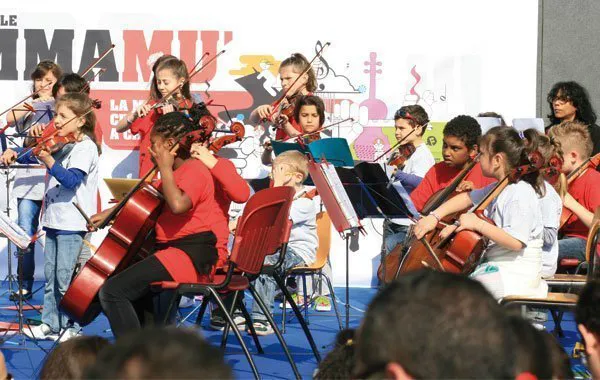
The Piagge Orchestra Nucleus, established at Duca D’Aosta Primary School, welcomes 50 children this year, playing both string and wind instruments, and offers them free, high-quality music education inspired by the discipline of ensemble playing and delivered by highly qualified teachers.
The creation of the Orchestra nucleus in the Piagge district is inextricably linked to the DNA of the Scuola di Musica di Fiesole. One might say that, as often happens in human life, on this occasion too the School has managed to remain what it has always been: an active force in spreading music education, including in areas where this may be more difficult, and a centre for research into innovative and experimental teaching methods. The teaching approach used in Piagge is the result of forty years of experience gained by the School in the field, together with a process of rethinking that experience.
Working with these children means abandoning every certainty. Academic knowledge and the certainties gained through experience have to be set aside. They are merely prerequisites. When faced with a child from an ethnic background different from your own, you have to question everything you believe you know. Paulo Freire said: “No one educates anyone, nor does anyone educate themselves: human beings educate one another in communion.” I do not know whether it was we or our students who learned more in Piagge.
The history of the Piagge neighborhood seems to encapsulate that of our country. Back in 1966, when the neighborhood was taking shape, Pasolini was completing the filming of Uccellacci e uccellini, while Celentano was singing Il ragazzo della via Gluck. In Piagge, the urban development plan that was supposed to create a model district was being eroded, clod by clod, by bulldozers, leaving behind a desolate landscape with an almost lunar appearance. The layout of the buildings and roads resembled a neo-Dadaist work more than a place designed for human beings. Don Lorenzo Milani had been acquitted at first instance of the charge of insulting military chaplains. He would be convicted in a final judgment after his death, but in the meantime he was preparing Lettera a una professoressa with his students, and the world would never be the same again. On the Fiesole hills, some of the intellectuals closest to the world of music were meeting. For them too, the spirit of that year was imbued with a desire for change, with the ambition to bring music and music education to the entire population of the country. Piero Farulli called on Italian intellectuals to recognise their duty to restore music to its rightful place among the forms of culture. Massimo Mila, music critic and member of the Giustizia e Libertà resistance movement, said of music that “the most suitable ground of all for promoting the development of culture, of any form of culture, is the school”.
The floods, the deaths of Pasolini and Don Milani were not enough to sweep away these ideas, which continued to grow. On the Fiesole hills, the School sought to continue its commitment to music education, reinforcing its belief in music as an integral part of culture; but not only that: music as an essential part of life, as a reason for living.
Living conditions for people in districts such as Piagge today are not as harsh as they were fifty years ago. The people who live there are open and interested, as much as and perhaps more than in other places. The challenges of integrating different ethnic groups have paradoxically also fostered greater tolerance and greater attention to finding solutions to these issues than can be found elsewhere.
The Piagge community is highly active and develops a range of initiatives of significant social and spiritual value. There are also positive signs of openness within ethnic communities that are not always particularly open, such as the Chinese community. As always, however, two fundamental problems remain. One concerns access to music education as education of intelligence and social skills. This is not a problem specific to Piagge. If it were, there would not be so many children’s orchestra nuclei throughout Italy. The other concerns the emptying of music itself, like an entire complex system of values, of its meaning. Genuine economic hardship has given way to something subtler and more difficult to resolve. The deprived neighbourhoods of metropolitan areas, with their dysfunctional architecture, are genuine societies in which, from the earliest age, the children born and raised there absorb an unconscious educational framework. In these spaces, therefore, a latent form of education operates which, paradoxically, makes us, our culture and our certainties the true outsiders.
Music too suffers from this process of removing its content. If 25 April is everybody’s celebration, if Allevi is like Mozart, what is the meaning and significance and what are the values of the world to which we belong? Don Milani coined the motto I care. It was the opposite of the notorious Fascist slogan “Me ne frego” (I don’t care). This is the only answer: we care. We take responsibility for it. The Piagge experience grew from the seeds carried by the wind of those years.
Coming here therefore meant forgetting everything we were: the Scuola di Musica di Fiesole, the high level of our training, excellence and all our certainties, and starting again from scratch. Starting again in terms of what to teach, but above all how to teach. Paulo Freire said: “No one educates anyone, nor does anyone educate themselves: human beings educate one another in communion.” I do not know whether it was we or our students who learned more here in Piagge.
Attempting an educational approach to this world means embracing an original way of working, free from prejudice and academic constraints. It means finally shedding — and it is high time — our sacred role as musicians, our ambitions and presumptions, and our unfortunate habit of shutting ourselves away as a caste. It also and above all means reflecting carefully on how to teach rather than on what to teach.
The principle underpinning the ideas that inspired the educational programme was that deprivation, even before hardship and marginalisation, is the cause of most problems affecting an individual’s intellectual development. Sound–Movement–Mind. This is the path of the human being: from the mother’s voice, through movement, the mind and thought emerge. Our task is to make human beings retrace this path in the opposite direction. From the mind, through movement, we arrive at sound. In this way, we seek to stimulate in children all those forms of perception that their environment had not, in some way, stimulated. If you want a strong statement, studying music truly means being reborn, both from an educational and a perceptual point of view.
The fact that the programme is aimed at the less advantaged sectors of society could never justify providing second-rate teaching. Up-to-date and passionate teaching must understand the gaps that may result from environmental deprivation or slower personal development, and must know how to address them. To do this, it must understand the processes through which the characteristics we ultimately call talent are formed in the mind.
Understanding talent requires a firm belief that it can be reproduced and reconstructed retrospectively. The Venezuelan model was certainly a major source of inspiration, although we considered it necessary, within the Italian social context, to devise flexible teaching methods that take territorial characteristics and variables into account. Another source of inspiration was teaching for people with disabilities.
What is opening up is certainly the century of music. As a result of an extraordinary acceleration that has taken place in recent years, we musicians suddenly find ourselves catapulted from the role of archaeologists that we once were to the front line of education.
Here in Piagge, as in Ramallah in Palestine, in Venezuela, but also in Medellín in Colombia during the era of the drug cartels, or in Mexico, as well as in Brooklyn, music points the way that takes human beings from fear towards freedom.
Acknowledgements
In this undertaking we are supported by a large number of friends: the luthiers Mecatti and Sorgentone, who with immense patience first lent and then repaired the instruments of the first students who did not have instruments of their own; Cristiano Onerati, who provided a large number of instruments free of charge, as well as an endless stream of suggestions; the Unicoop Piagge branch, which made a venue available for the wind section, inaugurating the specific project dedicated to it, significantly named Mammamù, Mamma Musica; the Friends of the Scuola di Musica di Fiesole for their indispensable and generous support; the Regione Toscana for its attention and support; and the University of Florence, which launched a Master’s programme to train new professionals to take the experience of music as a form of civic engagement wherever the wind may carry it.
To all of them, and to those who wish to join us and support us, we promise that these children will grow as human beings with the conviction and ability to stay together, united in achieving a common goal that is all the more important in a society built on principles of fragmentation.
Children living in District 5
Duca d’Aosta Primary School, Piazza Primo Maggio 12, 50145 Firenze
Unicoop Members’ Room, Centro Commerciale Le Piagge, Via Lombardia 17, 50145 Firenze
Open throughout the year
October to June
Free course