

Preparatory course for admission to the AFAM first-level programme in Sound engineering
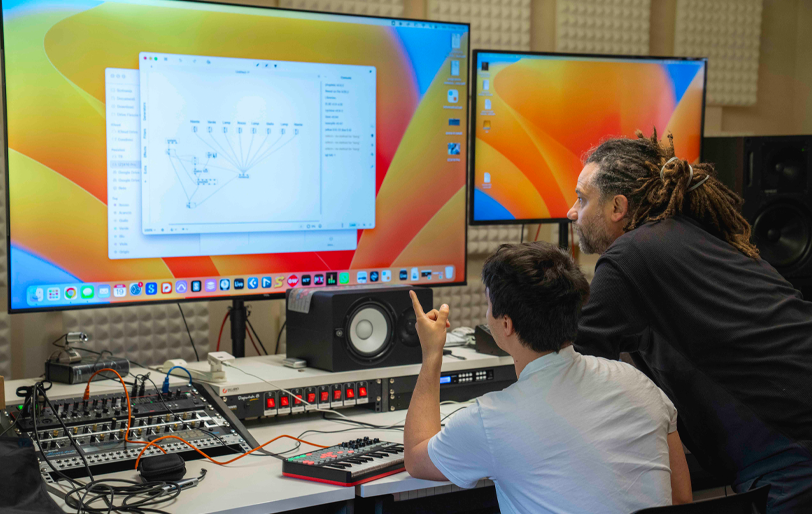
The Preparatory course for admission to the AFAM first-level programme in Sound engineering is designed to provide the fundamental skills required to understand and use audio technologies in the field of music. The programme introduces students to the principles of sound, recording and playback systems, and the use of digital tools for audio management and production, with particular attention to the relationship between sound, music and technology. Alongside these technological skills, the course also provides a solid foundation in music theory, harmony, and the historical evolution of musica language.
The first lessons focus on listening and observation activities aimed at understanding sound as both a musical and technological phenomenon. Initial sessions introduce students to the basic tools in the audio laboratory and the digital working environment, encouraging a gradual approach to the use of a Digital Audio Workstation (DAW) and the main recording and sound manipulation techniques. From the outset, teaching places particular emphasis on practical experience, supported by reflection on technical choices and their musical implications.
The course consists of two complementary types of group lessons.
Music technologies classes provide a broad introduction to the main aspects of sound, listening, and audio processes, offering an overview of technologies applied to music.
Software and systems for sound recording classes focus on the practical use of digital tools, recording systems, and DAW workflows, with particular attention to operational skills.
The programme is organised into progressive modules which combine theoretical instruction with practical laboratory activities.
Lessons include listening and analytical exercises, recording sessions, audio editing and processing within the DAW, and the creation of simple audio projects. Students’ progress is assessed through practical assignments, project work, and oral examinations evaluating both their understanding of the production process and the technical decisions they have made.
In addition to the weekly lessons in the main subject, students also attend three complementary subjects:
- music theory and sight-singing
- harmony
- history of music
Admission is based on an aptitude interview conducted by the course teachers and the programme coordinator.
General objectives
The course aims to provide students with the fundamental theoretical, technical, and practical skills required to understand, produce, process, and analyse sound and music using audio and digital technologies.
The programme integrates elements in acoustics, psychoacoustics, analogue and digital audio, DAW operation, sound processing, sound synthesis, and musical communication protocols, with a strong emphasis on laboratory practice.
It also provides the essential theoretical foundation required in the core musical subjects such as harmony, music theory and sight-singing, and history of music.
Fundamentals of sound and acoustics
Sound as a physical phenomenon
Sound propagation through elastic media
Fundamental parameters: frequency, period, wavelength, amplitude, phase, propagation speed
Periodic and aperiodic waves
Combination of sine waves
Harmonic content and waveforms
Representation of sound in the time and frequency domains
Sound envelope
Sound perception and listening
The auditory system and sound perception
Relationship between acoustic stimuli and auditory perception
Difference between the physical properties of sound and the subjective perception of pitch and loudness.
Fundamental perceptual phenomena relevant to musical and technical listening, including beating and masking
Introduction to spatial perception of sound, directionality, depth, and acoustic environment
Guided listening and perceptual analysis
Electroacoustic signal chain
Audio signal chain
Sound sources
Microphones
Preamplification
A/D and D/A conversion
Signal processing
Sound reinforcement
Analogue and digital domains
Noise and distortion
Microphones and Recording Techniques
Principles of microphone operation
Types of microphones
Polar patterns
Technical specifications of microphones
Basic microphone techniques
Mono and stereo recording
Introduction to the main stereo recording techniques
Practical laboratory applications
Digital Audio
Principles of digital audio
Sampling and quantisation
Sample rate and bit depth
Dynamic range
Audio file formats
Introduction to digital recording
DAWs and Workflow
Concept of the Digital Audio Workstation (DAW)
DAW architecture
Audio and MIDI tracks
Timeline, grid, tempo, and metre
Importing, recording, and basic editing
Level management
Audio project organisation
Bounce and export
Audio editing and processing
Basic audio editing
Fades, crossfades, and loops
Audio samples
Manipulation of recorded sound
Introduction to audio effects
Basic equalisation
Filters
Dynamics processing: compressor, limiter, and gate
Delay and reverb
Sound synthesis
Introduction to sound synthesis
Oscillators
Waveforms
Envelopes
Filters
LFOs
Subtractive synthesis
Overview of other synthesis techniques
Relationship between synthesis and timbre perception
MIDI and control
Digital control in music
MIDI protocol
Basic MIDI messages
Notes, velocity, and controllers
Relationship between MIDI and audio
MIDI within the DAW
Practical applications
Music production, listening, and musical context
Stages of music production
Recording, arranging, mixing, mastering
Critical listening
The relationship between sound, space, and musical context
Practical activities
Guided listening exercises
Analysis of sounds and musical works
Basic recording sessions
Creation of short audio projects
Basic audio editing and introductory sound design
Developing a conscious use of technology as a musical and expressive tool
Aspiring sound engineers
Paggeria, Medici Park of Pratolino (villa Demidoff) – via Fiorentina 276, Pratolino – Vaglia (Firenze)
Applications must be submitted by 1 September
From October to June
Fees vary according to the ISEE income indicator. Please click the “Fees” button for details
c.deiana@scuolamusica.fiesole.fi.it oppure 055/5978527
The course will be activated upon reaching the minimum required number of enrolments